Welcome To NailsFungus.org
Welcome to the Blog Section of NailsFungus.org

In this section you will find articles and videos on nail fungus and nail fungus treatments. Feel free to search for a subject concerning you or just browse around. We have amassed the largest informational database on nail fungus online and are here to help…
Curing Toenail Fungus with Prescription Drugs
Curing Toenail Fungus with Prescription Drugs
 Thanks to the advancements of modern medicine, curing toenail fungus with antifungal prescription medicines has become quite regular. As this is an infection that can spread easily, both throughout a person’s nails and through a populous, treating it has become of higher concern than it used to be.
What does an infected toenail look like?
The first and most common symptom to develop is a whitish or yellowish spot on your nail. Gradually this will cover your entire nail and you may eventually develop dark yellow and brown spots on the nail. Your nail will become thick and brittle as the fungus burrows deep into and underneath the nail on its quest to spread.
Infection occurs when people are exposed to the spores of the fungus. This can happen if you wander around barefoot, especially in areas that are particularly dirty, if your shoes are dirty or excessively damaged, and if you have particularly sweaty feet as heat and humidity are two key ingredients to a successful fungus growing environment.
Nails can become discolored due to trauma at the nail site, rubbing of the nail from the shoe and even if you have psoriasis. It is best to consult your doctor to determine what is causing the discoloration so that you can work together to come up with the best treatment.
Your doctor will take a sample of your nail and examine it under a microscope as well as have it sent to a lab for culture. The point of this exercise is to determine if it is a fungal or bacterial infection, and if it is a fungal infection, which type of fungus is it? The more you know, the more effective your treatment will be.
Topical Medications
A standard topical medication prescribed for toenail fungus infections is Ciclipirox, commercially known as Penlac. This comes as a nail polish, which needs to be applied daily to the infected nail to destroy the fungal infection. This can take several months to occur, so be patient.
Side Effects
Penlac has been known to cause skin irritation and itching where it has been applied.
Oral Antifungal Medications
Common prescriptives for eradicating toenail fungus infections are Lamisil, known as Terbinafine, Sporanox and Itraconazole. All of these drugs will run at least a twelve week course and it takes about nine months for the nail to grow out to fully replace itself.
All of these drugs come with the risk of side effects. If you suffer severe abdominal pain, headaches, dizziness or nausea, vomiting or jaundice in the skin or eyes or if your urine becomes particularly dark, you need to cease taking the medication and report this to your doctor right away.
None of these prescriptions are recommended for people with liver or heart disorders.
Thanks to the advancements of modern medicine, curing toenail fungus with antifungal prescription medicines has become quite regular. As this is an infection that can spread easily, both throughout a person’s nails and through a populous, treating it has become of higher concern than it used to be.
Proximal Subungual Onychomycosis (Nail Fungus)
Proximal Subungual Onychomycosis (Nail Fungus)
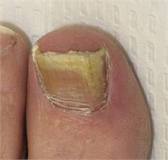 Least common in people with healthy immune systems but found frequently in people who have compromised immune systems, proximal subungual onychomycosis stands out because the progression of the disease starts at the cuticle and grows out with the nail.
Proximal subungual onychomycosis usually causes the nail to become disfigured, as in other nail fungus infections, but as it starts at the cuticle and works its way up, it is more likely to infect the nail bed early on, causing the nail bed to develop bumps and irregularities. This then may cause the nail plate to become dislodged and fall off, exposing the nail bed to possible further infection.
Similar to distal subungual onychomycosis, the majority of cases of proximal subungual onychomycosis are caused by the same dermatophyte, Trichophyton ruburm. However this particular nail fungus infection can also be caused by a different dermatophyte, Trichophyton mentagrophytes. Proximal subungual onychomycosis can also be caused by molds. Another defined symptom of proximal subungual onychomycosis is the skin around the nail may become swollen, red and inflamed and may start to ooze pus. This is more commonly seen when the nail fungus infection is caused by molds than by dermatophytes.
Unfortunately, these distinguishing symptoms are what cause proximal subungual onychomycosis to be misdiagnosed as a bacterial infection instead of a fungal infection by some physicians. As antibiotics do not kill fungi, this course of treatment does nothing to stop the infection. An antifungal is required to eradicate molds, yeasts and dermatophytes.
Proximal subungual onychomycosis occurs more often in people who have depressed or deficient immune systems. It is rarely seen in people with good immunity. Immunodepression can be caused by procedures like chemotherapy or in people who are recovering from an autoimmune disease or an organ transplant and have had their immune system deliberately suppressed.
Proximal subungual onychomycosis occurs frequently in people with unhealthy immune systems and even more commonly in people with human immunodeficiency virus or HIV. This is such a common occurrence that if a patient contracts this form of nail fungus infection and no other cause can be found, the doctor will likely suggest an HIV test. Be prepared if you have a fungal nail infection and it is discovered to be proximal subungual onychomycosis, to have your doctor suggest an HIV test. This is a test that requires your consent to perform. And just because you may receive a diagnosis of proximal subungual onychomycosis doesn’t necessarily mean that you have contracted HIV.
The only way to cure proximal subungual onychomycosis is to take an oral antifungal medication. If the nail fungus is caused by dermatophytes Trichophyton rubrum or Trichophyton mentagrophytes then it is likely that your doctor will prescribe terbinafine, also known as Lamisil. The dose is usually one 250 mg pill once a day for six weeks for a fingernail infection and twelve weeks for a toenail infection. A nice thing about Lamisil is that it is usually less expensive than the other current generation antifungals.
Itroconazole, or Sporanox, is used for treatment when the cause of the proximal subungual onychomycosis is unknown because it is effective against both dermatophytes and Candida infections. This tends to be a more expensive treatment method than some of the others.
Fluconazole commercially known as Diflucan, is able to treat proximal subungual onychomycosis but is not used as often as the other available medications. This medication stops the fungal growth and therefore the spread of the disease but does not kill the fungus itself. The difference between these two processes is referred to as fungistatic (stopping growth) and fungicidal (killing growth).
This particular drug tends to slow down the growth so that the immune system can take care of it on its own. As many of the cases of proximal subungual onychomycosis happen in people with previously depressed immune systems, this is not necessarily the best drug choice. Fluconazole (Diflucan) is taken until the symptoms resolve and the infection is gone.
 Posted in Nail Fungus, Nail Fungus Infection, Nail Fungus Topical, Onychomycosis |
  Tags: nail fungus infection, onychomycosis
What are the symptoms of a Nail fungus and how can I tell if I have a Nail Fungus Infection?
What are the symptoms of a Nail fungus and
how can I tell if I have a Nail Fungus Infection?
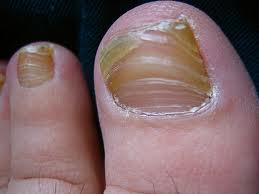 You’d think these would be fairly straightforward questions that ought to illicit simple answers. Unfortunately not only is this not true, but it is confusing enough that sometimes doctors misdiagnose nail fungus (or onychomycosis). Knowing the symptoms will assist you in helping your doctor to order the appropriate diagnostic tests so that you end up with the correct solution to your problem.
There are two basic causes of nail infections. Bacterial and fungal. Onychomiycosis, or fungal nail infection, is usually caused by a dermatophyte called Trichophyton rubrum. If not, it is caused by Candida albicans, a yeast growth (also a fungus). As nail infections differ in variety and in cause, the correct cure must be applied. A fungal infection should be treated with an anti-fungal whereas a bacterial infection should be treated with an antibiotic.
Onychomycosis affects the nail bed (skin underneath the nail) nail plate (the hard surface that we refer to as the nail) or the skin around the nail. About one third of skin infections and half of nail infections are caused by Onychomycosis. The visual signs are the abnormalities caused by the nail fungus. A white or yellowish crust appears on top of or embedded in the nail. This is the actual fungus growth. Sometimes it appears as streaks that follow the line of the nail against the infected digit (finger or toe) and sometimes it appears at the cuticle (soft area at the base of the nail). As the fungus spreads, it covers the entire surface of the nail, turning it to a milky white or yellow. Frequently it causes the nail to become ridged and deformed. This is a result of the dermaptophytes emitting destructive waste product as a result of consuming keratin. If the fungus gets underneath the nail plate, it can cause the nail bed to become irregular. This causes the nail plate to release from the bumpy nail bed and the nail becomes loose and can fall off.
If the nail fungus infection becomes severe, or if it contains Candida, the area around the nail can become swollen and sensitive to the touch. The skin may express (think ooze) pus and be very uncomfortable, even painful. These are common signs of infection. The pus is a result of white blood cells rushing to the area to fight off the infection. This is your body trying to do its job and tell you and your doctor that something is wrong.
It is most common for pus to be present in the case of bacterial infections. Thus your doctor should check for this before looking for fungal infections. To add to the confusion, there are diseases that mimic a nail fungus, including hallopeau acrodermatitis, lichen planus, nail bed psoriasis (which can occur in conjunction with fungal infection of the nail), nail bed melanoma, Reiter syndrome, yellow nail syndrome, onycholysis, and paronychia. Because of this factor, more than one test may be necessary to determine the correct course of treatment.
Different forms of onychomycosis will require different samples from the affected area. In some cases the nail can be sampled from the end or the top can be scraped for a sample, in others, the nail will need to be removed entirely. Whereas this can be a bit scary, it is also to your advantage as it then exposes the nail bed so that it can be treated.
The most typical tests performed on a nail culture to look for onychomycosis are a potassium hydroxide wash, which allows for the sample to be put under a microscope and searched for evidence of fungal growth, or a fungal culture, where the sample piece of nail is put in an environment (usually a petri dish) where it has the necessary components to thrive and create new growth, thus showing what kind of fungal infection it is. In the unlikely event that neither of these tests show positive for onychomycosis, the remaining nail sample can be pulverized and sent to a pathology lab for analysis or submitted for a bacterial culture if it is determined that the infection is bacterial instead of fungal.
Determining what kind of infection you have and what to do about it are very important when dealing with a nail infection of any kind. Having the infected area looked at by a physician, preferably a dermatologist, is the best way to deal with these diseases as they can help to rule out and diagnose serious problems as well as knowing what to do about the infection in the first place.
Myxiod Cyst or Digital Mucous
Myxiod Cyst or Digital Mucous
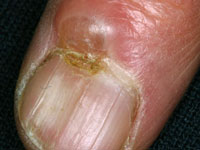 A Myoxid cyst develops because of alterations in the tissue on the tip of the toe. A cyst is a shiny, smooth bump. It is soft and rubbery and looks sort of transparent. When they develop, it is usually towards the end of fingers or toes. Usually they are about 1/5-3/5 inch wide and form in a circular or ovoid shape. Digital Mucous occurs when these cysts burst and emit a thick fluid, whitish or yellowish in color. These cysts occur more commonly in women and in people 45 years or older.
What Causes This?
Myxoid cysts usually develop where a recent minor trauma or an old injury have occurred. Friction (similar to a blister) is also a culprit. Submerging your hands in water for a long time can make these cysts occur as your body soaks up the liquid and it collects as a bump, potentially developing a bit of an infection.
How Do I Treat It?
The nice thing about this particular disease is that there is no urgency in seeking treatment until it becomes painful or begins to throb. Sometimes this disease is self- curing and it just goes away, it can also be eliminated by pressing on or squeezing the cyst. Medically, the popular way to remove these cysts is cryotherapy or freezing.
- Cryotherapy is the process of freezing an area of skin to kill off infection. The most commonly used freezing chemicals are liquid nitrogen, carbon dioxde snow, propane, and Dymethy ether. Of these, liquid nitrogen us most used. This has become a very safe, fast and effective way of removing many kinds of unwanted cysts and warts.
- Liquid Nitrogen (NO2) Treatment – A cryoprobe, cryospray or coated cotton tipped applicator is applied to the affected area. This freezes the cyst and allows the skin to heal.
- CO2 Snow Treatment – Carbon Dioxide Cryotherapy uses a tube of icy carbon dioxide flurry, sprayed directly onto the affected skin
- DMEP treatment – Using a foam applicator, the chemical is applied directly to the affected area for between 20 and 50 seconds, depending on the size and place on the body.
Myxoid cysts can be removed surgically but this increases the possibility that they will reoccur. If you choose this method, your doctor will examine the cyst with an ultra-sound or x-ray. It is also likely that an MRI will be scheduled.
If the cyst is not particularly painful, your doctor can insert a needle into the cyst and withdraw the fluid that way, leaving the skin to heal.